Source Spacious Hanging Fabric Toiletry Bag for Travel Shopping Daily Life
Compare 30 listings for the spacious hanging fabric toiletry bag, featuring customizable sizes, waterproof polyester options, and single-open designs. Buyers can evaluate suppliers offering OEM/ODM services with sample lead times of 5-7 days for travel and daily use applications.
Key considerations
Products List




Comprehensive Sourcing Guide
Strategic Sourcing Guide for Spacious Hanging Fabric Toiletry Bags
The global market for travel accessories has seen a sustained shift toward multifunctional, space-efficient storage solutions, with the spacious hanging fabric toiletry bag emerging as a critical category for both B2B distributors and retail buyers. This guide provides a disciplined, evidence-based framework for sourcing these products, relying strictly on verified product attributes and established procurement principles. The focus is on identifying specifications that ensure functionality, durability, and market fit while avoiding unverified claims regarding certifications or performance metrics.
Defining Technical Specifications and Material Composition
The foundational step in sourcing a spacious hanging fabric toiletry bag involves a rigorous analysis of material composition and structural design. Based on the observed product data, the primary material categories identified include Fabric, Polyester, and PU (Polyurethane). Each material offers distinct advantages depending on the intended use case. Polyester is frequently cited as a robust option, often paired with waterproof attributes, making it suitable for environments where moisture resistance is paramount. Conversely, PU materials are noted for their specific aesthetic qualities, often aligning with European styles, though buyers must verify the waterproof status on a per-product basis, as some PU variants are listed as non-waterproof.
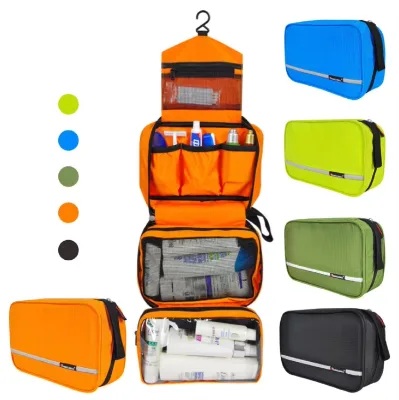
The physical dimensions of these bags are a critical differentiator. The data indicates a standard specification of 40cm x 35cm x 12cm, which defines a "spacious" profile capable of holding multiple toiletries. However, the attribute "Customized" appears repeatedly for size, suggesting that many suppliers offer bespoke dimensions to meet specific retail requirements. The shape is consistently rectangular, providing a stable footprint when hung. The "Folded" attribute indicates that these units are designed for compact storage during transit or shipping, which significantly impacts logistics costs. Furthermore, the "Single Open" feature suggests a specific access mechanism, likely a wide-mouth design that facilitates easy retrieval of items.
| Attribute Category | Observed Variations | Sourcing Implication |
|---|---|---|
| Material | Fabric, Polyester, PU | Verify water resistance and texture; Polyester often implies higher durability. |
| Dimensions | 40cm x 35cm x 12cm (Standard), Customized | Confirm if standard sizing meets volume needs or if custom molds are required. |
| Waterproof | Waterproof, Non-Waterproof | Critical for travel; must be verified per SKU to prevent leakage issues. |
| Fastener | Zipper | Standard closure; check zipper quality and smoothness during sampling. |
| Shape | Rectangular | Ensures stability when hanging; ideal for maximizing internal volume. |
Customization Capabilities and Brand Integration
For B2B buyers, the ability to customize is often as important as the product itself. The data confirms that customization is available across multiple dimensions, including logo application, size, and design. The "Logo" attribute appears in various forms, ranging from "Customized" to specific techniques like "Silkscreen Logo" and "Gold/Silver Foil." This indicates a high degree of flexibility for brand integration. The "OEM/ODM" and "OEM & ODM Service" attributes are marked as acceptable, suggesting that suppliers are willing to produce goods based on buyer-provided designs or specifications.
The "Style" attribute reveals a divergence in market offerings. While some products are labeled "Original" or "Newest Fashionable," others are explicitly categorized as "European Style." This distinction is vital for targeting specific demographic segments. For instance, a "European Style" bag with mixed colors may appeal to a different consumer base than a "Single Open" bag with a minimalist aesthetic. The "Special Treat" attribute mentions "Pitch New Ideas/Trendy/Styles for Inspiration," implying that suppliers may offer design consultation services. Buyers should leverage this to align product aesthetics with current market trends without incurring excessive design costs.
Cost Drivers and Minimum Order Quantity Analysis
Understanding the cost structure is essential for maintaining healthy profit margins. The observed price range in the market is between 0.5 and 15 USD, a wide spectrum that reflects variations in material quality, customization complexity, and order volume. The Minimum Order Quantity (MOQ) ranges from 20 to 3000 units, with a specific data point noting an MOQ of 500 PCS for certain models. This variance allows buyers to scale their orders based on cash flow and inventory risk tolerance.
Several factors drive the final unit cost. First, the material choice is a primary driver; PU and specialized waterproof fabrics typically command higher prices than standard fabric. Second, the customization level significantly impacts cost. Adding a custom logo via silkscreen or foil stamping requires additional setup and labor, which may increase the unit price. Third, packaging requirements play a role. The data lists "OPP Bag" and "1PC/Poly Bag + Carton" as common packaging methods. More complex packaging, such as individual polybagging with specific carton configurations (e.g., 15-20 PCS per carton), adds to the overall cost.
Sample costs are another consideration. The data indicates a sample charge of 25 USD for small goods and 50 USD for bags. This fee is standard in the industry to cover the cost of prototyping and shipping. Buyers should budget for this initial expense, noting that sample lead times are typically 5-7 business days. This rapid turnaround allows for quick iteration on design and material selection before committing to a full production run.
Compliance, Certification, and Quality Verification
When evaluating suppliers, compliance and certification checks are paramount, though the available data presents a nuanced picture. While background knowledge suggests certifications like BSCI and ISO 9001:2015 are relevant in the industry, the specific product data does not explicitly confirm these certifications for the listed items. Therefore, buyers must treat certification status as a verification point rather than an assumed attribute. The procurement strategy should include a direct request for certification documents to ensure the supplier adheres to ethical labor practices and quality management standards.
Quality control for toiletry bags focuses on several key areas. The "Hardness" attribute is listed as "Medium Soft," which suggests a balance between structure and flexibility. Buyers should verify that the fabric maintains this hardness after repeated use and washing. The "Zipper" fastener is a common point of failure; rigorous testing should be conducted to ensure smooth operation and resistance to jamming. Additionally, the "Waterproof" claim requires physical testing. Since some products are marked as waterproof and others as non-waterproof, buyers must request water resistance test results or conduct their own immersion tests to validate the manufacturer's claims.
The "Packaging" attribute, specifically "Individual OPP Bag Packing," indicates a level of protection during shipping. However, the durability of the outer carton (e.g., 15-20 PCS per carton) must be sufficient to prevent crushing during transit. Quality control protocols should also inspect the stitching and seam integrity, as these are critical for the bag's longevity, especially given the "Travel" intended use.
Supplier Evaluation and Operational Capabilities
Selecting the right supplier involves assessing their operational capabilities and communication standards. The data highlights a "Service" attribute of "24/7 Fast Reply/Excellent Communication," which is a strong indicator of a responsive supply chain. In the context of B2B procurement, timely communication is essential for resolving production issues, tracking shipments, and managing customizations. The "Sample Time" of 5-7 days further demonstrates operational efficiency, allowing buyers to move quickly from concept to prototype.
The "Designs" attribute notes "100 PCS Monthly New Arrivals," suggesting a supplier with a dynamic design team capable of keeping pace with fashion trends. This is particularly valuable for buyers looking to refresh their product lines regularly. However, buyers should verify the actual production capacity to ensure the supplier can handle large orders without compromising quality or lead times. The "prod_origin" is listed as "China" and specifically "Anhui," providing geographical context. While this location is a major manufacturing hub, buyers should verify the specific factory conditions and logistics capabilities to ensure reliable delivery.
Typical Applications and Market Segmentation
The intended use cases for these bags are clearly defined in the data, primarily targeting "Travel" and "Shopping, Daily Life." The "Gender" attribute is listed as both "Unisex" and "Female," indicating that the product line serves a broad market. The "Spacious" nature of the bag, combined with the "Hanging" functionality (implied by the category and typical toiletry bag design), makes it ideal for travelers who need to keep toiletries organized in hotel bathrooms or shared spaces.
The "Rectangular" shape and "Folded" capability make these bags highly portable, a key selling point for the travel market. For the "Daily Life" segment, the "Waterproof" attribute adds value for users who may need to store wet items or use the bag in humid environments like gyms. The "Mixed Color" option suggests a strategy to appeal to a diverse consumer base, allowing retailers to stock a variety of colors to match different customer preferences.
Long-Term Procurement Considerations
Sourcing is not a one-time transaction but a long-term partnership. Buyers should consider the scalability of the supplier. The ability to accept "Customized" orders and the availability of "OEM/ODM" services suggest that the supplier can grow with the buyer's business. The "Sample Lead Time" of 5-7 business days is a positive indicator for maintaining agility in the supply chain.
However, buyers must remain vigilant about the variability in product attributes. The presence of both "Waterproof" and "Non-Waterproof" options, as well as different materials like "Fabric" and "PU," requires careful selection to ensure consistency in the final product line. Establishing clear quality standards and communication protocols early in the relationship will help mitigate risks associated with product inconsistency.
In conclusion, sourcing a spacious hanging fabric toiletry bag requires a methodical approach that balances technical specifications, customization needs, and cost considerations. By focusing on verified attributes such as material composition, dimensions, and packaging, and by rigorously checking compliance and supplier capabilities, buyers can build a reliable supply chain. The wide range of observed prices and MOQs offers flexibility, but success depends on precise communication and a clear understanding of the product's intended application in the travel and daily life markets.
FAQs
What materials are used for spacious hanging fabric toiletry bags?
These bags are commonly made from Fabric, Polyester, or PU materials. Polyester is often selected for its durability and waterproof properties, while PU offers a specific aesthetic suitable for European styles, though waterproof status varies by product.
Can I customize the size and logo on these toiletry bags?
Yes, customization is available for both size and logo application. Buyers can request specific dimensions like 40cm x 35cm x 12cm or fully customized sizes, and logos can be applied via silkscreen or foil stamping techniques.
What is the typical minimum order quantity for these bags?
The minimum order quantity ranges from 20 to 3000 units depending on the supplier and product model. Some specific models may require an MOQ of 500 pieces, while others allow for smaller trial orders starting at 20 units.
How long does it take to receive a sample of the bag?
Sample lead times are typically 5 to 7 business days for production. Buyers should expect a sample charge of 25 USD for small goods or 50 USD specifically for bags to cover prototyping and shipping costs.
Are these toiletry bags waterproof and suitable for travel?
Waterproof status varies by product, with some options listed as waterproof and others as non-waterproof. They are designed for travel and daily life, featuring a rectangular shape and zipper fasteners to ensure portability and organization.
Which packaging methods are used for shipping these bags?
Products are typically packed in individual OPP bags or poly bags within cartons. Standard configurations often include 15 to 20 pieces per carton, ensuring protection during transit while maintaining a compact shipping profile.